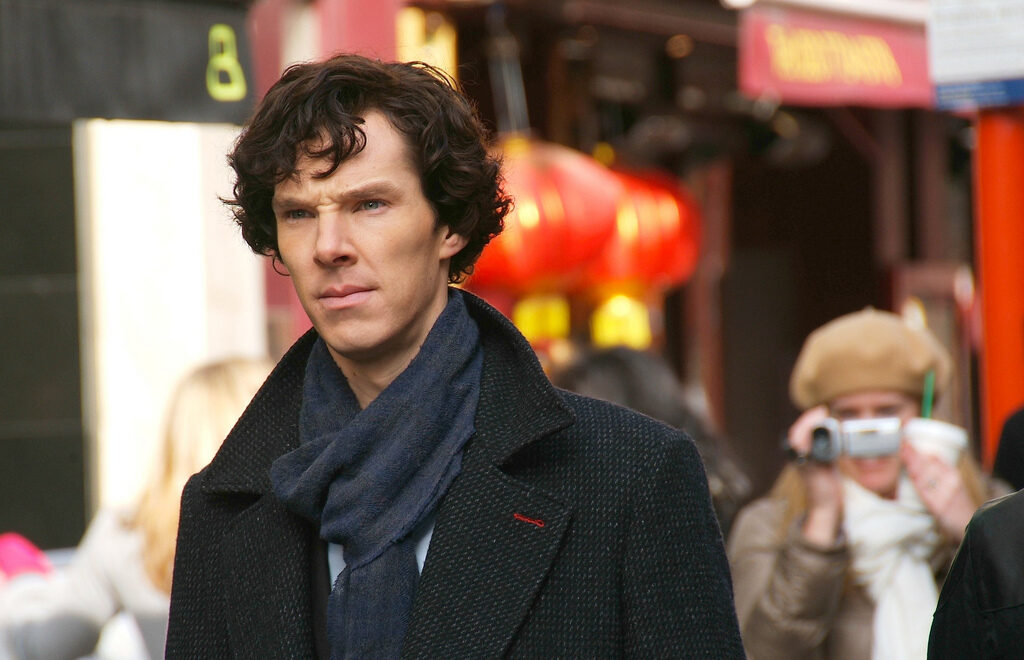
Benedict Timothy Carlton Cumberbatch was born on 19 July 1976 in Hammersmith, London, into a family already familiar with the spotlight. His parents, Timothy Carlton and Wanda Ventham, were both working actors, and Cumberbatch has spoken about the modest but steady nature of their careers. He attended Harrow School on an arts scholarship before taking a gap year that would become part of his personal lore: he taught English for a period at a Tibetan monastery in Darjeeling, India, and also hiked in Nepal. After returning, he studied drama at the University of Manchester and then classical acting at the London Academy of Music and Dramatic Art (LAMDA), earning a master’s degree. His early career included a lean stretch of about six months without acting work, during which he took jobs in restaurants to get by.
From Stage to Screen
Cumberbatch’s first screen credit came in 2000 with an episode of the long-running television series Heartbeat, but his real education came in the theatre. In 2001 he appeared in Love’s Labour’s Lost and A Midsummer Night’s Dream at the Regent’s Park Open Air Theatre, and he spent the following years building a reputation in productions at the Almeida and the Royal Court. Television roles in the early 2000s included Tipping the Velvet, Silent Witness and Fortysomething, while his portrayal of Stephen Hawking in the 2004 BBC film Hawking earned him a BAFTA nomination and a Monte Carlo Television Festival award. He followed that with a second Monte Carlo win for the miniseries To the Ends of the Earth. On stage, his performance in Hedda Gabler brought an Olivier Award nomination for best supporting actor.
The turning point came in 2010 when he was cast as Sherlock Holmes in the BBC’s contemporary update of Arthur Conan Doyle’s detective. Sherlock made him a household name in Britain and beyond, and his portrayal won him an Emmy for outstanding lead actor in a miniseries or movie, along with a Critics’ Choice Television Award and a Satellite Award. The role also brought three BAFTA nominations and a Golden Globe nomination. In 2011 he appeared opposite Jonny Lee Miller in Danny Boyle’s National Theatre production of Frankenstein, with the two actors alternating the roles of Victor Frankenstein and the Creature; both men shared the Olivier Award for best actor. Cumberbatch also won the London Evening Standard Theatre Award for the same production. Around this time he began a long association with motion-capture and voice work, playing the dragon Smaug and the Necromancer in Peter Jackson’s The Hobbit trilogy, which began with An Unexpected Journey in 2012.
Hollywood and the Marvel Universe
Cumberbatch’s film career gathered pace in 2013 when he played the villain Khan in Star Trek Into Darkness, a performance that won him a Saturn Award for best supporting actor. That same year he portrayed Julian Assange in The Fifth Estate, and he appeared in Steve McQueen’s 12 Years a Slave. In 2014 he starred as Alan Turing in The Imitation Game, which earned him an Academy Award nomination for best actor and a Golden Globe nomination. The following year he received a CBE in the Queen’s Birthday Honours for services to the arts and charity, and he was invited to join the Academy of Motion Picture Arts and Sciences.
In 2016 Cumberbatch took on the role of Dr Stephen Strange in Marvel’s Doctor Strange, a character he has played across several films, including Avengers: Infinity War, Avengers: Endgame and Spider-Man: No Way Home. He returned to the role in 2022 for Doctor Strange in the Multiverse of Madness, which was among the highest-grossing films of that year. Away from blockbusters, he has worked with directors such as Jane Campion on The Power of the Dog (2021), which brought him a second Oscar nomination, and Sam Mendes on 1917 (2019). On television, his performance in the 2018 miniseries Patrick Melrose won him the BAFTA TV Award for best actor. In 2013 he founded the production company SunnyMarch, which has since been involved in several film and television projects.
Stage and Other Work
Cumberbatch has never abandoned the theatre. In 2015 he played Hamlet at the Barbican in London, a production that was broadcast to cinemas as part of the National Theatre Live series. He has also lent his voice to documentaries, audiobooks and radio dramas, and his distinctive baritone has become a familiar sound in everything from BBC nature programmes to animated films. In 2026 he is scheduled to appear in a National Theatre Live broadcast of Hamlet, and he continues to balance studio films with smaller, character-driven projects.
Personal Life and Philanthropy
Cumberbatch married theatre and opera director Sophie Hunter in 2015. The couple have three sons. Despite his global fame, he has generally kept his family life private and has spoken about the challenges of managing a career that takes him around the world. He has also been open about his experiences with grief, particularly in relation to his role in the 2025 film The Thing with Feathers, an adaptation of Max Porter’s novel about a bereaved father, which premiered at the Sundance Film Festival.
Charity work has been a consistent thread in his public life. He is an ambassador for The Prince’s Trust, the youth-support charity founded by King Charles III, and for the Motor Neurone Disease Association, a cause he has supported for many years. He has also worked with Dramatic Need, which uses the arts to help young people in developing communities, and has taken part in campaigns for Save the Children, Cancer Research UK and Stand Up To Cancer, among others. In 2015 his CBE recognised this philanthropic work alongside his acting achievements.
Net Worth and Public Perception
Like many actors of his stature, Cumberbatch’s exact financial position is not publicly documented. Celebrity Net Worth, a website that publishes unverified estimates, has placed his fortune at approximately US$40 million (around R$205 million at the time of writing). That figure should be treated as an estimate only; it is not based on verified financial disclosures. The bulk of his income is understood to come from his acting roles, endorsements and production work, but no official records confirm the total. Readers should be cautious about treating any single figure as definitive.
Frequently Asked Questions
What role made Benedict Cumberbatch famous?
His breakthrough came in 2010 with the BBC series Sherlock, in which he played a modernised Sherlock Holmes. The role won him an Emmy and made him internationally known.
Has he won any Oscars?
He has been nominated twice for an Academy Award for best actor: for The Imitation Game (2014) and The Power of the Dog (2021). He has not won a competitive Oscar.
Is he married?
Yes. He married Sophie Hunter, a theatre director, in 2015. They have three children.
What is his net worth?
Estimates vary. The most frequently cited figure comes from Celebrity Net Worth, which puts it at around US$40 million, but this is an unverified estimate and should not be treated as fact.
What is he doing next?
He has a National Theatre Live production of Hamlet scheduled for 2026 and is set to appear in the film The Gentleman’s Action in 2027, among other projects.
Featured image: Fat Les (bellaphon) from London, UK / Wikimedia Commons (CC BY 2.0).
