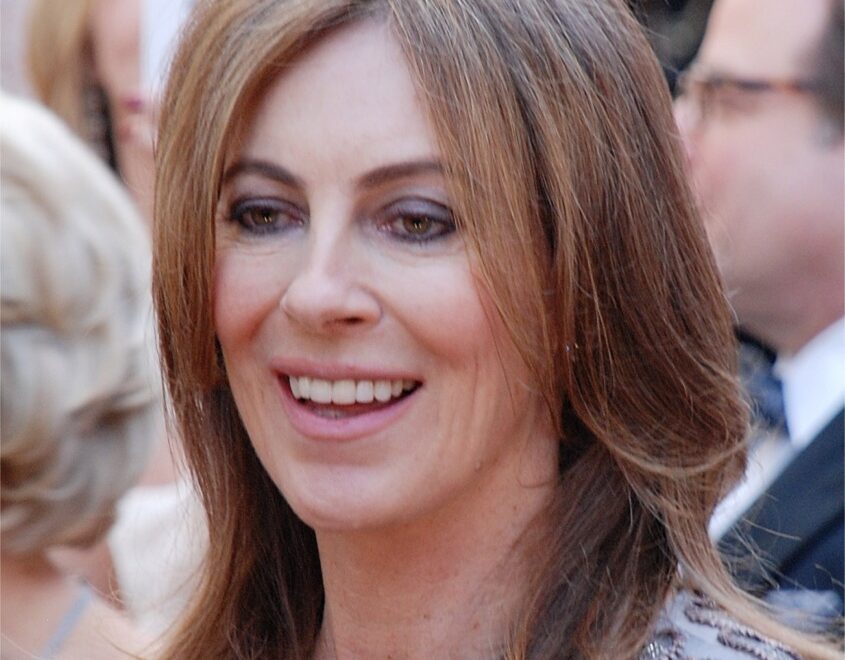
Kathryn Bigelow is an American filmmaker known for her visceral, immersive approach to genre cinema. Over a career spanning more than four decades, she has directed cult classics, Oscar-winning dramas, and provocative thrillers, earning a reputation as one of the most distinctive voices in contemporary film.
Early Life and Artistic Beginnings
Kathryn Ann Bigelow was born on November 27, 1951, in San Carlos, California, the only child of Gertrude Kathryn (née Larson), a librarian, and Ronald Elliot Bigelow, a paint factory manager. She attended Sunny Hills High School in Fullerton, California, before enrolling at the San Francisco Art Institute in fall 1970, where she studied painting and earned a Bachelor of Fine Arts degree in December 1972.
During her time at SFAI, Bigelow was accepted into the Whitney Museum of American Art’s Independent Study Program in New York City from fall 1971 to spring 1972. There, she studied under artist Brice Marden and critic Susan Sontag. After graduating, she returned to New York and lived as an impoverished artist, at one point staying with painter Julian Schnabel in performance artist Vito Acconci’s loft. To support herself, she partnered with composer Philip Glass on a real-estate venture renovating distressed apartments downtown. As Bigelow later recalled, “He [Glass] would do the plumbing, and I would do the Sheetrock.”
Bigelow then entered the graduate film program at Columbia University, where she studied theory and criticism and earned a master’s degree. Her professors included Vito Acconci, Sylvère Lotringer, Susan Sontag, Andrew Sarris, and Edward W. Said. She also worked with the Art & Language collective and Lawrence Weiner, and published an article, “Not on the Development of Contradiction,” in the short-lived Art & Language magazine The Fox. During this period, she began her short film The Set-Up (1978), a 20-minute deconstruction of violence in film that caught the attention of director Miloš Forman, who offered her a scholarship to Columbia’s film school.
From Painter to Filmmaker
Bigelow’s transition from painting to film was driven by a desire to reach a wider audience. She felt that painting was “somewhat elitist,” while cinema could cross class boundaries. Her short The Set-Up features two men fighting while semioticians Sylvère Lotringer and Marshall Blonsky deconstruct the images in voice-over. Bigelow asked her actors to actually beat and bludgeon each other throughout the all-night shoot.
Her first feature was The Loveless (1981), a biker film she co-directed with her film school classmate Monty Montgomery. It starred Willem Dafoe in his first leading role. That same year, she was invited by artist John Baldessari to teach for a semester at the California Institute of the Arts.
Breakthrough and Signature Style
Bigelow’s early films established her fascination with genre and her knack for subverting conventions. Near Dark (1987), a neo-Western vampire film she co-wrote with Eric Red, starred three actors from Aliens. She followed it with Blue Steel (1990), starring Jamie Lee Curtis as a rookie police officer stalked by a psychopathic killer. The film was originally budgeted at $10 million but was shot on location in New York City due to financial constraints; Bigelow noted that she doesn’t “like movies where you see a welfare apartment and it’s the size of two football fields.”
Her breakthrough came with Point Break (1991), a cult classic starring Keanu Reeves as an FBI agent who infiltrates a gang of bank-robbing surfers led by Patrick Swayze. The film was Bigelow’s most profitable studio film at the time, grossing about $80 million worldwide, though critics argued it conformed to action-genre clichés.
In 1993, she directed an episode of the TV series Wild Palms and appeared uncredited in one episode. Her 1995 film Strange Days, written and produced by her ex-husband James Cameron, was a commercial failure despite some positive reviews. Bigelow has said, “If there’s specific resistance to women making movies, I just choose to ignore that as an obstacle for two reasons: I can’t change my gender, and I refuse to stop making movies.”
Oscar Triumph with The Hurt Locker
Bigelow’s career reached new heights with The Hurt Locker (2008), a tense drama about an American bomb-disposal team in the Iraq War. The film received nine Oscar nominations and won six, including Best Picture and Best Director. On March 7, 2010, Bigelow became the first woman to win the Academy Award for Best Director. She was presented the award by Barbra Streisand, who remarked, “Well, the time has come.” Bigelow later returned to the stage to accept the Best Picture Oscar as a producer.
She scaled back the film’s budget to retain creative control, shooting in Jordan on a small budget. She told Slant magazine in 2009 that she wanted to give the audience a “boots-on-the-ground, you-are-there look” at bomb disposal, requiring “a kind of presentational, reportorial, immediate, raw, visceral approach.”
Zero Dark Thirty and Controversy
Bigelow’s next film, Zero Dark Thirty (2012), written by Mark Boal and starring Jessica Chastain as a CIA analyst, dramatized the hunt for Osama bin Laden. The film became a flashpoint over its depiction of CIA torture. Three senators, Dianne Feinstein, Carl Levin, and John McCain, sent a letter to Sony Pictures Entertainment calling the film “factually inaccurate” for suggesting that torture had directly led to intelligence that located bin Laden.
Bigelow said she was “mystified” by the vociferous reactions. She noted that McCain and Feinstein left after the first 20 minutes and missed a scene in which a CIA operative receives information after giving a prisoner food and a cigarette, a moment based on “a generous gesture, as opposed to a harm.” The controversy did not prevent the film from receiving five Oscar nominations, including Best Picture.
Detroit and A House of Dynamite
In 2017, Bigelow directed Detroit, a drama about racial unrest in Detroit following a 1967 police raid on a bar. The film received mixed reviews; critic K. Austin Collins wrote in The Ringer that it failed to wonder whether the rioters had a political imagination.
Bigelow’s latest film, A House of Dynamite (2025), is a thriller about a nuclear missile headed toward the United States. It premiered in theaters in October 2025 and began streaming on Netflix on October 24, 2025. The film was her first feature since Detroit and her first studio-financed movie, bankrolled by Netflix. It was largely well-received but did not stir the excitement or controversy of her earlier work. Bigelow said she would “love to initiate, or help initiate, a conversation about reducing the nuclear stockpile.”
She has been reluctant to discuss being a female director, saying such framing “ghettoizes women.” In the years since The Hurt Locker, only two other women have won Best Director: Chloé Zhao for Nomadland (2021) and Jane Campion for The Power of the Dog (2022).
Personal Life
Bigelow was married to director James Cameron from 1989 to 1991. She has no publicly known children and maintains a private personal life. She has been riding horses since childhood and now lives on a sweeping estate in upstate New York, where she keeps a few bays and some other people’s horses. She moved from Los Angeles after enduring too many fires.
Net Worth
Public estimates of Kathryn Bigelow’s net worth vary. As with many entertainment figures, these figures are unverified and should be treated as speculative.
| Source | Estimated Amount | Date/Year | Caveat |
|---|---|---|---|
| Bored Panda | $20 million | 2025 | Unverified estimate; not confirmed by Bigelow or her representatives. |
No other reliable sources with explicit estimates were found. Bigelow’s actual wealth is not publicly documented.
Frequently Asked Questions
What is Kathryn Bigelow known for?
She is known for directing intense action and war films such as The Hurt Locker, Zero Dark Thirty, and Point Break. She is the first woman to win the Academy Award for Best Director.
What was Kathryn Bigelow’s first film?
Her first feature was The Loveless (1981), co-directed with Monty Montgomery.
Did Kathryn Bigelow win an Oscar?
Yes, she won Best Director and Best Picture for The Hurt Locker at the 82nd Academy Awards in 2010.
What is Kathryn Bigelow’s latest movie?
Her latest film is A House of Dynamite (2025), a nuclear thriller released in theaters and on Netflix.
Is Kathryn Bigelow married?
She was married to James Cameron from 1989 to 1991. She has not publicly confirmed any other marriages or partnerships.
Featured image: Cristiano Del Riccio / Wikimedia Commons (CC BY-SA 2.0).
