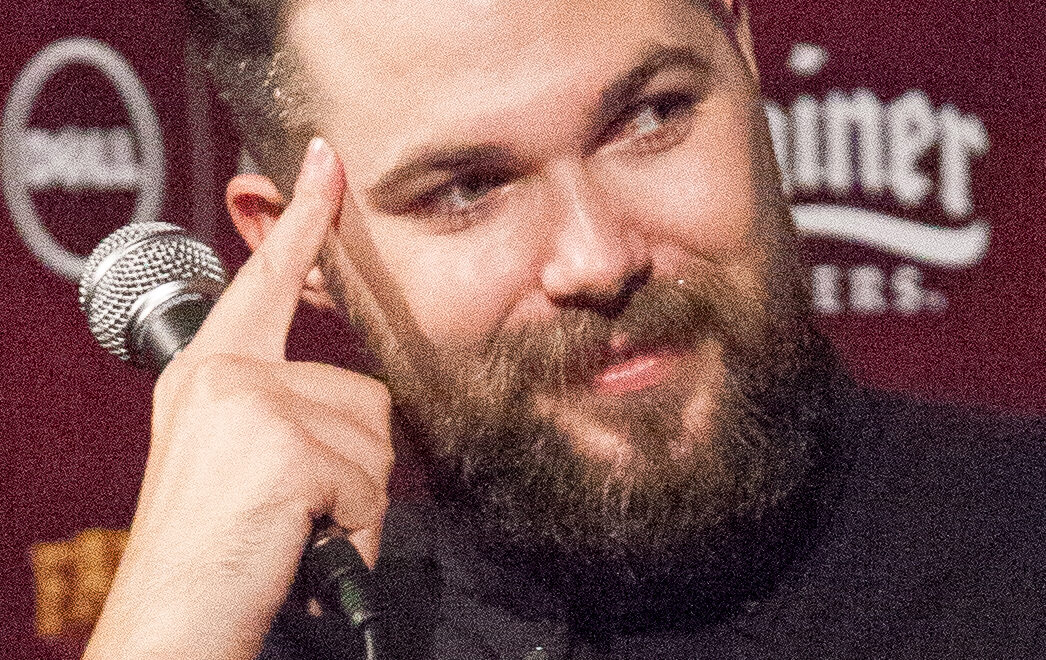
Robert Houston Eggers has built a career on a simple, stubborn conviction: if the world on screen is not real down to the grammar of its dialogue and the grain of its wood, then nothing built on top of it can be trusted. Across four features in under a decade, that conviction has made him one of the most distinctive American filmmakers of his generation and one of the few directors whose name alone signals a particular experience at the cinema.
Early Life and a Childhood Steeped in Folklore
Eggers was born on July 7, 1983, in New York City. He moved with his mother to Wyoming, where she later met and married Walter Eggers. When his stepfather became provost of the University of New Hampshire, the family settled in the small town of Lee, New Hampshire.
That New England setting mattered. As a child Eggers was drawn to comics, but an introduction to woodcuts sparked a deeper fascination with satyrs, demons and the stranger corners of old stories. He has described folklore, fairy tales, comparative religion and mythology as his abiding interests, and the dilapidated colonial farms and witch lore of his childhood surroundings became raw material he would return to again and again.
As a teenager he helped run the Oyster River Players, a children’s theater company co-run by his mother, staging plays he also acted in. In 2001 he enrolled at the American Musical and Dramatic Academy in New York, and he kept returning to New Hampshire to mount productions.
From Stage Design to Short Films
Eggers worked as a designer across theater, dance, television, film and print while making his own short films. In 2007 his black and white silent adaptation of the Brothers Grimm tale Hansel & Gretel screened at the Boston Underground Film Festival. The following year he adapted Edgar Allan Poe into the short The Tell-Tale Heart, which played at the Los Angeles International Short Film Festival and the Woods Hole Film Festival in 2009.
These early shorts served as a laboratory. The uncanny tone, the period textures and the willingness to work in archaic forms that would define his features were already visible in miniature. His production design background gave him something many first time directors lack: a working knowledge of how physical environments shape a story rather than merely decorate it.
The Witch and the Arrival of a Singular Voice
Eggers wrote and directed The Witch, his first feature, released in 2015. Starring Anya Taylor-Joy alongside Ralph Ineson and Kate Dickie, the film follows a religious 17th century New England family after its youngest member vanishes. Eggers spent roughly four years researching Puritan beliefs, period vocabulary and grammar, and witch folklore while developing the project.
The film premiered at the Sundance Film Festival in 2015, where Eggers won the directing award. It went on to earn two Film Independent Spirit Awards, for best first feature and best first screenplay, and it introduced Taylor-Joy to a wide audience. A24 acquired the film and released it theatrically in February 2016. The film’s commitment to Early Modern English dialogue and historical detail immediately set Eggers apart from his contemporaries.
The Lighthouse: Isolation in Black and White
His second feature, The Lighthouse (2019), starred Willem Dafoe and Robert Pattinson as lighthouse keepers in the late 19th century. Eggers co-wrote the screenplay with his brother, Max Eggers. The film was shot in black and white in a boxy 1.19:1 aspect ratio to mirror late 19th century cinema, and the production used lenses from the early 20th century.
It premiered at the Cannes Film Festival in 2019, where it won the FIPRESCI Prize, and it earned an Academy Award nomination for cinematography. The film confirmed that Eggers’ method could survive a shift in setting and register. Where The Witch drew on religious archives, The Lighthouse drew on maritime logs and the psychology of isolation, but the underlying discipline was the same.
The Northman and the Move to Studio Scale
Eggers’ third feature, The Northman (2022), starred Alexander Skarsgård as a Viking prince seeking to avenge his father’s death. The story is loosely based on the legend of Amleth, a likely fictional Viking figure who also inspired Shakespeare’s Hamlet. Eggers co-wrote the film with the Icelandic novelist Sjón.
The cast included Nicole Kidman, Ethan Hawke, Claes Bang, Anya Taylor-Joy and Willem Dafoe. The film premiered in Stockholm in March 2022 ahead of its April release. It was Eggers’ first experience directing at a large studio scale, and it demonstrated that he could stage visceral action without abandoning the historical rigor that defines his work.
Nosferatu and a Lifelong Obsession
Eggers first saw F. W. Murnau’s Nosferatu at age nine. As a teenager he staged a silent play version of the story at a small New Hampshire theater. The idea of remaking the 1922 vampire film followed him for roughly two decades, and it was announced soon after his Sundance win for The Witch.
His version began filming in Prague in February 2023 and was released in U.S. theaters on December 25, 2024. The cast included Lily-Rose Depp, Bill Skarsgård, Aaron Taylor-Johnson, Nicholas Hoult, Emma Corrin and Willem Dafoe. The film reached theaters to positive reception, closing a creative circle that had opened in his childhood.
How Eggers Works: Research as Foundation
Eggers’ process is unusually research intensive for a working director. The pattern is consistent across his filmography:
- Written sources first. Diaries, court records, theological texts and period vocabulary informed The Witch.
- Physical accuracy. Cameras, lenses, aspect ratios and built environments are chosen for their historical fidelity, not convenience.
- Long development cycles. Projects spend years in research and writing before cameras roll.
- Collaborators who share the standard. Cinematographers, designers and actors are drawn into a rigorous working method.
The result is a body of work with a recognizable signature, one that critics have consistently praised for its stylistic command and its attention to folklore and period detail.
Net Worth and What Is Actually Known
Public information about Robert Eggers’ personal finances is thin, and directors’ compensation is rarely disclosed in the way actors’ salaries sometimes are. What is documented is the shape of his film career: a feature debut at a modest independent budget, a critically acclaimed second feature, an ambitious studio scale third film, and a long awaited fourth feature released wide at Christmas in 2024.
Some third party websites have published net worth figures for Eggers, but these are unverified estimates rather than confirmed financial disclosures. They should be read as media speculation, not as documented fact. Any number attached to a director’s name in this category typically derives from assumptions about fees and back end participation rather than from any public filing, and it can change substantially with each project.
Why His Films Stand Apart
The most striking thing about Eggers as a director is how well his approach holds together across wildly different settings. A Puritan farmstead, an isolated lighthouse, a Viking settlement and a Carpathian castle all share a common grammar: they are researched, they are physical, and they are inhabited by people whose beliefs are treated seriously rather than condescended to.
That seriousness is the through line. His characters live inside systems of meaning, whether Calvinist theology, maritime superstition or Norse fate, and the films take those systems at face value. Horror, in his hands, is less a genre category than a consequence of a world that operates on rules outside modern comfort.
Frequently Asked Questions
What was Robert Eggers’ first feature film?
The Witch, released in 2015 and distributed by A24, which won him the directing award at Sundance.
Which films has Robert Eggers directed?
The Witch (2015), The Lighthouse (2019), The Northman (2022) and Nosferatu (2024), along with several short films including Hansel & Gretel and The Tell-Tale Heart.
Who co-wrote The Lighthouse and The Northman?
Eggers co-wrote The Lighthouse with his brother, Max Eggers, and The Northman with the Icelandic novelist Sjón.
When did Nosferatu come out?
Eggers’ Nosferatu was released in U.S. theaters on December 25, 2024.
Is Robert Eggers’ net worth publicly confirmed?
No. Any net worth figure circulating for Eggers is an unverified estimate from third party outlets, not a confirmed or officially disclosed number.
The Road Ahead
Eggers has spent his career proving that an obsession with authenticity can be a commercial and artistic asset rather than a liability. Each film has widened his range while keeping his method intact, and the result is a filmography that reads as the work of one very specific mind rather than a series of hired assignments. Whatever he directs next, audiences have learned to expect the same things: a carefully built world, a willingness to unsettle, and the sense that every detail on screen survived a long argument with the historical record.
Featured image: Anna Hanks from Austin, Texas, USA / Wikimedia Commons (CC BY 2.0).
