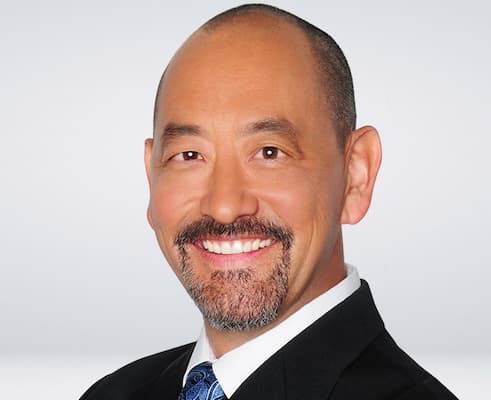
Mark Kono’s Biography
Mark Kono is a renowned American pilot/reporter currently working on Sky5 at KTLA Morning News. He has been a professional helicopter pilot for over 25 years, his operational experience includes electronic news gathering (ENG), aerial photography, executive charter, production, offshore and lifesaving medical flights.
Kono began his flight training in a Robinson R22, learning to fly at Hiser Helicopters in 1988 in Corona, California. Hiser was an organization that was in its heyday in the 1980s and 1990s. Essentially training local and foreign pilots who were sent to the United States to obtain initial ratings in the R22 and then, on a student basis, they would often finish a course of turbine transition on a Bell 206 or MD500 before returning to Asia.
Kono traveled to different parts of the country and flew for several major media outlets including KSAZ-TV in Phoenix and KGO-TV in San Francisco, KNBC-TV, KCBS-TV, KABC-TV and KTTV-TV in Los Angeles. Lately, his work has been featured in various publications such as Heliweb Magazine, Roadkill and Hot Rod Network.
……
Unfortunately, after getting his private helicopter rating, he ran out of money. He had to put his flight on hold and went back to non-flying roles to save more money to complete his ratings. Kono’s return to flight training to finish his commercial, CFI and instrument ratings came in 1992 when he was able to restart with a now-defunct company located outside of Long Beach Airport called “Everything Flyable”. The company was started by a wealthy businessman who did his flight training at the same airport and saw some gaps in the training offered and once completed he decided to start a company with the newest aircraft, amazing team of instructors and the best facilities. According to Mark, this strategy paid off.
However, with a lot of investment in aircraft, payroll, facilities and a slight drop in student enrollment, the company closed after five years of operation.
…….
However, by the time Everything Flyable came to an end, Kono had already acquired the remaining ratings he needed and was hired after graduating as a CFI. By getting more flight hours, Kono got an opportunity at Helinet Aviation in the early 1990s for a “porter” position. The job required flights on bank runs that were carried out by helicopter from airports and off-site locations in Van Nuys, John Wayne, Fullerton, El Monte, among others. The helicopter would then return to downtown Los Angeles, landing on bank roofs delivering the day’s checks for processing. Mike’s job was to load the bags in and out of the helicopter at each location.
Before the current Helinet ownership took over, Kono states that “all the loaders were pilots and we were all working primarily in a ground crew role, but the benefit was you were getting turbine time.” In races where the helicopter was empty, Kono and his colleagues were able to log turbine hours slowly, sometimes in increments as small as 0.2 or 0.3 at a time. This process was tedious, but ultimately it all added up, and the drivers for the bank race service became the next PIC candidates, selected from the pool of drivers based on their experience and skills.
………
Kono says at the time it was difficult to secure full-time pilot jobs. Vietnam-era helicopter pilots still held many flight positions. For example, at that time, Robinson’s 2,000-hour pilots had a hard time getting into a turbine position that they could easily acquire in today’s world in the Grand Canyon or Alaska, where employers put him in a turbine transition. Additionally, Mark took his second hiatus from a pilot role to seek a higher paying land job. After a while, Kono returned to flying full-time.
Additionally, his return to aviation necessitated a move to Louisiana, landing in oil and gas work, working for Tex-Air Helicopters. The company was owned by a family that served the oil and gas industry. Era bought Tex-Air and took over its fleet after Mike’s departure.
Likewise, during his time in the Gulf he flew many different airframes, including: the AS30, EC120, AS355, and even the first Agusta Westland A119 in the Gulf of Mexico, of which Tex-Air was the first recipient. The company also ran the first generation EC225 for larger transports to the oil fields. Mark worked in the Gulf for a year and a half, accumulating a significant amount of hours and experience before returning permanently to Los Angeles.
Mark Kono Age
How old is Mark Kono? Kono managed to keep his personal life private. However, he celebrates his birthday on May 6th every year. He still hasn’t revealed the year and month he was born. We guarantee to keep you informed as soon as the information is available in the spotlight.
Mark Kono family
Due to her secret personal life, no information is available about her parents and siblings.
Mark Kono’s Wife
Kono married Chan ginger, a fellow KTLA 5 Morning News anchor. The KTLA 5 couple celebrated their anniversary in July 2018. Their fellow KTLA 5 anchor/reporter Lynette Romero shared a short clip of their celebration on Twitter and said she loves the combination of KTLA’s husband and wife team.
Kono and his wife three children. Your eldest son, Ryder Ronorejoiced the moment his twin brothers were born in May 2014. Devyn Doris Kono is the eldest sister, as she was born a minute earlier Alyssa Rose Kono. Devyn Doris weighed 5 pounds 9 ounces while her younger sister Alyssa Rose weighed 5 pounds 8 ounces at birth.
The duo’s twins reached the age of three in May 2017. Their proud mother Ginger Chan took to her Instagram page and wished her adorable daughters a happy birthday. She also shared a throwback photo where the twins enjoyed the company of their older brother Ryder.
Mark Kono’s height
Kono has yet to reveal her exact height and weight. However, we will update this section as information becomes available.
Mark Kono Salary
Kono get an estimate annual salary from among $40,000 – $110,500.
Mark Kono net worth
Kono have an estimate net worth ranging between $1 million – $5 million. Her income is mainly attributed to her successful career as a journalist.