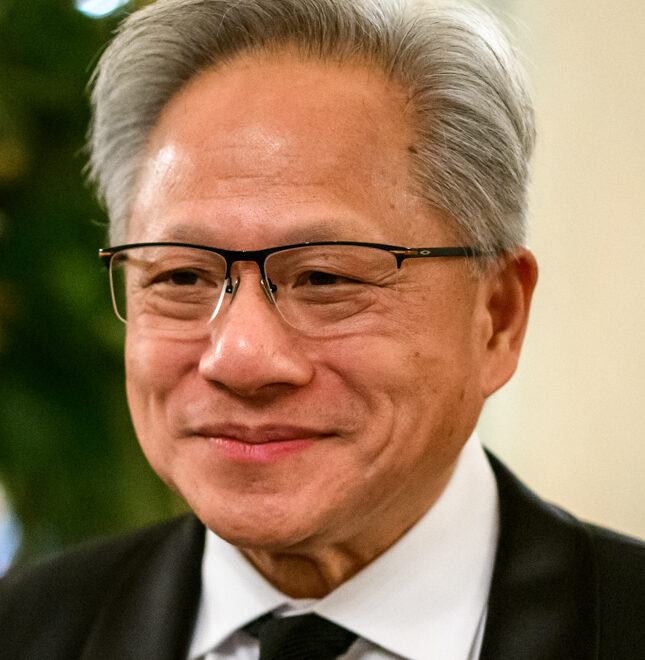
Jensen Huang has become the public face of the artificial intelligence boom, but his path to the top of the semiconductor industry began far from Silicon Valley. Born Jen-Hsun Huang in Taipei in 1963, he was sent as a young boy to the United States with his brother. The brothers ended up at a boarding school in rural Kentucky that turned out to be a reform institution rather than the prestigious academy their family had expected. Huang has spoken about cleaning toilets and being bullied there, and he has also said he came to value the experience.
His parents later settled in Oregon, where Huang finished high school early and enrolled at Oregon State University to study electrical engineering. He graduated with high honors in 1984 and went on to work at Advanced Micro Devices and LSI Logic before cofounding Nvidia in 1993 with Chris Malachowsky and Curtis Priem. The three sketched out the company’s founding idea in a Denny’s booth in San Jose, and Huang, who had once worked shifts at the chain, was 30 years old when Nvidia launched.
From graphics cards to AI infrastructure
Nvidia’s early business focused on chips that could render 3D graphics for computer games. The company introduced the first graphics processing unit, or GPU, in 1999. Over the following two decades, Huang pushed the company to adapt its parallel computing architecture to new uses, including data centers, cloud computing and scientific research. That bet positioned Nvidia at the center of the generative AI wave when demand for its hardware surged.
The result has been a corporate ascent without close precedent. Nvidia became the first company to surpass a $4 trillion market valuation in 2025, and it has since grown further. Its GPUs are used to train and run large AI models, and its customers include many of the largest technology companies in the world. Huang has described Nvidia as the smallest large company in the world, noting its workforce of roughly 40,000 people and unusually low turnover.
Leadership style and public profile
Huang is known for his signature black leather jacket, his marathon keynote presentations and his habit of speaking without notes. He has become a celebrity in Taiwan, where fans crowd him for selfies and follow him to night markets. Within Nvidia, he is described as demanding and fiercely protective of employees, with a management style that mixes blunt criticism with loyalty.
He has also become a familiar voice on the future of work. In a 2026 interview after receiving the IEEE Medal of Honor, Huang argued that engineering will remain one of the most important career paths in the AI era, calling it the profession that turns inventions into safe and transformative tools for society. He has encouraged young people to become fluent in AI, describing it as a technology that lowers the knowledge barrier across fields.
Net worth and Nvidia stake
Huang’s personal wealth is tied overwhelmingly to his stake of roughly 3.5 percent in Nvidia. That figure has risen sharply as the company’s share price has climbed, and published estimates of his fortune have varied widely by outlet and date. Such figures are unverified estimates, not audited statements of wealth, and they change with daily market movements.
| Source | Published estimate | Date/year | Caveat |
|---|---|---|---|
| AFP via BSS News | About $150 billion | July 2025 | Unverified estimate based on Nvidia stake valuation at the time |
| The Age | About $170 billion (roughly $250 billion AUD) | January 2026 | Unverified estimate; publication described him as the world’s ninth-richest person |
| Fortune via Yahoo Finance | About $196 billion | 2026 | Unverified estimate subject to market fluctuation |
| Yahoo/Fortune feature | Above $175 billion | 2026 | Unverified figure from a profile placing him among the top 10 richest people |
The wide range between these figures reflects differences in publication date, share price and methodology. Readers should treat each number as a snapshot of an estimate rather than a confirmed valuation.
Personal life and philosophy
Huang met his wife, Lori Mills, in an electrical engineering classroom at Oregon State. They married and have two children. He has said that his definition of success has shifted over time, and that the purpose of work ultimately lies with family and the people one loves rather than with technology or wealth alone.
He is also known for his views on resilience. Huang has said that meaningful achievements require difficulty, and that his own advantage has been low expectations combined with stubborn persistence. He has described working seven days a week, driven by a lasting fear that Nvidia could fail, a fear he says has not faded over more than three decades of running the company.
What comes next
Huang has said he has no plans to step down and has spoken of leading Nvidia for decades more. The company continues to announce new chip platforms and to expand its role in data centers, robotics and AI infrastructure. With Nvidia now systemically important to global markets, questions about succession and the concentration of AI spending follow him, but Huang has so far answered them by staying in the job and keeping the company’s product cadence at the center of the conversation.
Frequently asked questions
Who is Jensen Huang?
Jensen Huang is the cofounder, president and chief executive of Nvidia, the semiconductor company at the center of the AI boom.
When and where was Jensen Huang born?
He was born in Taipei, Taiwan, in 1963 and moved to the United States as a child, later settling in Oregon.
How did Nvidia start?
Huang cofounded Nvidia in 1993 with Chris Malachowsky and Curtis Priem. The idea was sketched out in a Denny’s booth in San Jose.
What is Jensen Huang’s net worth?
Published estimates of his wealth have ranged from roughly $150 billion to nearly $196 billion in recent reporting. These are unverified estimates tied to the value of his Nvidia shares and change with the stock price.
Is Jensen Huang still CEO of Nvidia?
Yes. As of the latest reporting, Huang remains chief executive and has said he intends to continue leading the company.
Featured image: The White House / Wikimedia Commons (Public domain).
