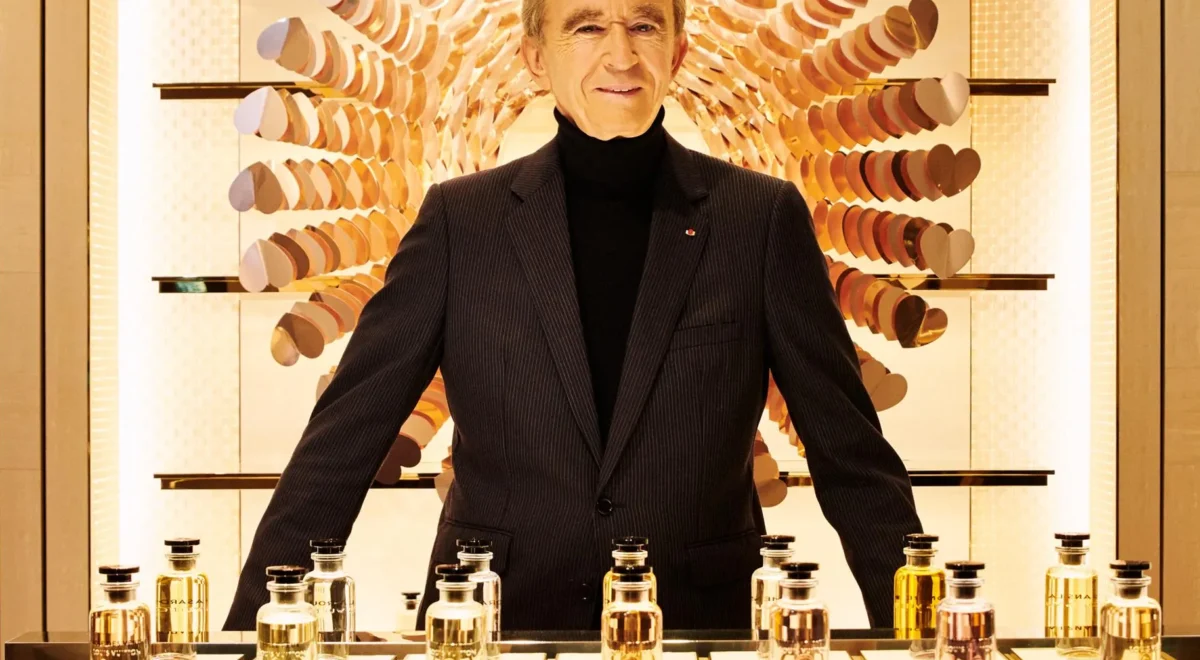
Bernard Arnault is not a household name in the way his brands are. Yet the French businessman has shaped the global luxury landscape for decades as chairman and CEO of LVMH Moët Hennessy Louis Vuitton, the conglomerate behind Louis Vuitton, Dior, Tiffany & Co., Moët & Chandon, and Sephora, among many others. His story is one of relentless ambition, meticulous control, and a family dynasty in the making.
Early Life and the Roots of Ambition
Born in 1949 in Roubaix, a town in northern France, Arnault was raised largely by his grandmother, whom he affectionately called “Maminette.” She instilled in him a drive for success, often telling him, “The price of excellence, or nothing!” This ethos would come to define his career. After earning an engineering degree from the École Polytechnique, he joined his father’s construction company, Ferret-Savinel, eventually taking the reins and steering it toward real estate.
The Birth of a Luxury Empire
Arnault’s entry into luxury came in 1984, when he acquired the struggling textile conglomerate Boussac, which owned Christian Dior. He sold off most of its assets, keeping Dior and using it as a springboard. By 1989, he had gained control of LVMH after a fierce boardroom battle, and he quickly set about transforming it into a global luxury powerhouse through strategic acquisitions and bold investments. Over the decades, LVMH added brands such as Louis Vuitton, Givenchy, Kenzo, Guerlain, and later Tiffany & Co., Bulgari, and Rimowa, among others.
Leadership Style: Control and Excellence
Arnault is known for his hands-on approach. According to a France Info profile, he personally inspects one of his stores every Saturday, paying attention to details like displays and lighting. He is said to review the design of handbags and visit workshops to feel the materials. “When you want to do something and do it well, you have to work,” he told France Info. His discipline is legendary: he arrives at his office on Avenue Montaigne by 8:30 a.m., never goes to bed after 11 p.m., and drinks only water. He fears illness and death, and undergoes blood tests regularly.
Rivalry and Competition
Arnault’s competitive streak extends beyond business. He plays tennis, sometimes with Roger Federer, who described him as “incredibly competitive.” His rivalry with François Pinault, another French luxury titan, became public in 1999 when Pinault’s group acquired Gucci, a move Arnault contested. The two went on to compete in art foundations and auction houses, with Arnault acquiring Phillips and creating the Fondation Louis Vuitton in Paris, while Pinault established his own foundation in Venice.
Family and Succession
Arnault has five children, all of whom hold key positions within LVMH. His daughter Delphine is executive vice president, and his sons Antoine, Alexandre, Frédéric, and Jean are involved in various brands. The question of succession looms large, but Arnault has generally avoided public discussion of it. In 2022, LVMH proposed changing its bylaws to raise the age limit for chairman and CEO to 85, a move seen as extending Arnault’s reign.
Wealth and Philanthropy
Arnault’s personal fortune fluctuates with the stock market. According to France Info, estimates have ranged between €120 billion and €200 billion in recent years, although he insists money is “not at all a motivation.” He has occasionally ranked among the world’s richest individuals. In a rare podcast interview, he revealed that he invested early in Netflix and Google, though he sold the Netflix stake prematurely. He also owns Les Echos and previously owned La Tribune, reflecting an interest in media influence.
Controversies
Arnault’s career has not been without controversy. The 2016 documentary Merci Patron! highlighted the case of workers laid off by a subcontractor of LVMH, and it was reported that Arnault sent an infiltrator to try to stop the film. The documentary was a critical and commercial success, winning a César Award. He has also faced criticism over tax issues and his influence on French politics and media.
Legacy and the Future
At 77, Arnault shows no signs of slowing down. His legacy is already cemented through the Fondation Louis Vuitton, a striking Frank Gehry-designed building in the Bois de Boulogne that houses his art collection. As he continues to expand his empire, the world watches to see how the Arnault dynasty will evolve and who will eventually take the helm of the world’s largest luxury company.
Frequently Asked Questions
Who is Bernard Arnault?
Bernard Arnault is a French billionaire businessman, the chairman and CEO of LVMH, the world’s largest luxury goods conglomerate. He is one of the wealthiest individuals in the world.
What brands does LVMH own?
LVMH owns over 70 brands, including Louis Vuitton, Dior, Tiffany & Co., Moët & Chandon, Hennessy, Sephora, Bulgari, and many others across fashion, cosmetics, watches, jewelry, wines, and spirits.
How did Bernard Arnault become rich?
Arnault built his fortune through strategic acquisitions and the transformation of LVMH into a global luxury leader. His early move to acquire Christian Dior and then LVMH itself laid the foundation for his wealth.
Is Bernard Arnault married?
Yes, he is married to Hélène Mercier, a pianist. He was previously married to Anne Dewavrin, with whom he had two children.
Who will succeed Bernard Arnault?
Succession remains uncertain. All five of his children hold roles within LVMH, and the company has raised the age limit for its CEO to 85, suggesting Arnault may stay at the helm for years to come.
What is Bernard Arnault’s net worth?
Estimates of his net worth vary with market conditions. Sources like France Info have reported figures between €120 billion and €200 billion in recent years. These are unverified estimates and should be treated as approximate.