
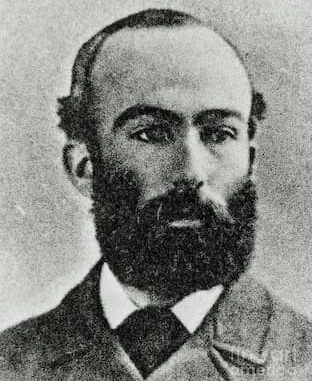
William Morris Davis was an American geographer, geomorphologist and meteorologist. He became famous as the meteorologist who founded the science of geomorphology, the study of landforms. Often called the “father of American geography.” Davis studied geology and geography at Harvard’s Lawrence Scientific School. Later joined the Harvard-sponsored geographic exploration group of the Colorado Territory, led by inaugural Sturgis-Hooper Professor of Geology Josiah Dwight Whitney.
He was the founder of the Association of American Geographers in 1904. Additionally, he was heavily involved with the National Geographic Society in its early years, writing several articles for the magazine. Davis retired from Harvard in 1911. He served as president of the Geological Society of America in 1911. He was awarded the patron medal of the Royal Geographical Society in 1919.
Wild stories circulated since soon after the Louisiana Purchase about Rocky Mountain peaks 18,000 feet or higher. The Harvard expedition began to investigate and found nothing, but they did find “14ers” (over 14,000 feet). He graduated from Harvard University in 1869 and received a master’s degree in Mining Engineering the following year. Davis worked for Nathaniel Shaler as a field assistant and was later hired to teach at Harvard. Although his legacy lives on in geomorphology, he also developed theories of scientific racism in his writings on physical geography.
Davis initially worked in Córdoba, Argentina as a meteorologist for 3 years and after working as an assistant to Nathaniel Shaler, he became an instructor in geology at Harvard in 1879. In the same year he married Ellen B. Warner of Springfield, Massachusetts. Although Davis never completed his doctorate, he was appointed full professor in 1890 and remained in academia and teaching throughout his life.
He was a tenacious and perceptive observer of nature, a master of logical deduction, and a brilliant synthesizer of disparate observations and ideas. He crafted his most influential scientific contribution; the “geographical cycle”. His theory was first defined in his 1889 paper, The Rivers and Valleys of Pennsylvania, which was a model of how rivers erode land raised to ground level and was inspired by the work of Erasmus and Charles Darwin.
Although the cycle of erosion was a crucial early contribution to the development of geomorphology, many of Davis’s theories on landscape evolution, sometimes called ‘Davisian geomorphology’. they were heavily criticized by later geomorphologists. When Davis retired from Harvard in 1911, the study of landscape evolution was almost monopolized by his theories.
His book, Elementary Physical Geography (1902), includes a chapter titled “The Distribution of Plants, Animals, and Man.” In which Davis details how the physical geography of landscapes influences man’s progress from the savage to the civilized state. This chapter of the book exemplifies how Davis borrowed Darwinian biological concepts and applied them to physical landscapes and climate. in a type of social Darwinist thinking called “environmental determinism”. His work influenced geographer and writer Elsworth Huntington, a student of Davis’s at Harvard, who attempted to explain differences in human culture through climate and geography. for example, comparing communities of British descent in Canada and the Bahamas and suggesting that Anglo-Bahamians are slower due to climate and proximity to blacks.
William Davis Age
Davis was born on February 12, 1850, but died in Pasadena, California, just before his 84th birthday. His home in Cambridge is a National Historic Landmark.
William Davis parents
William was born into a prominent Quaker family in Philadelphia, Pennsylvania. He is the son of Edward M. and Maria Mott Davis (daughter of women’s advocate Lucretia Mott).
Wife of William Davis
Davis after the death of his first wife, he married Mary M. Wyman of Cambridge, Massachusetts in 1914, and after her death, he married Lucy L. Tennant of Milton, Massachusetts in 1928, who survives him. David had two daughters; Jane Alice Morris and May Morris.
William Davis net worth
The estimate of William’s net worth was unknown and corresponded to his annual salary. But we know he had a successful career as “The Father of American Geography.”